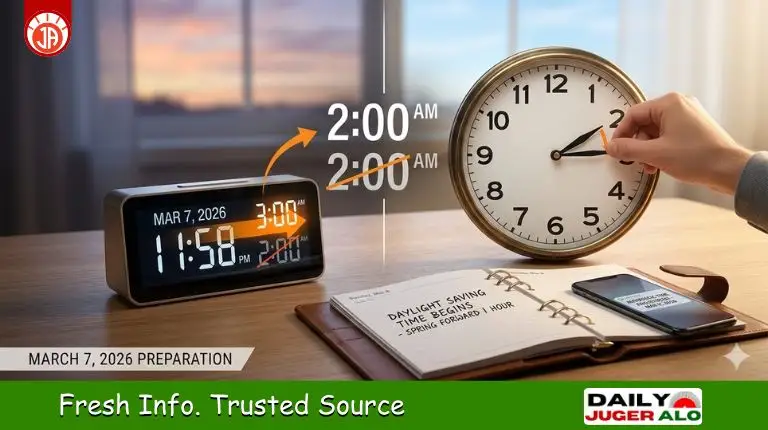
The annual ritual of “Spring Forward” is officially here. Before you head to bed this Saturday evening, March 7, 2026, make sure to prepare your clocks for the shift. Daylight Saving Time 2026 officially begins in the early hours of Sunday morning, marking a significant transition as we move closer to the spring equinox.
At exactly 2:00 a.m. on Sunday, March 8, clocks across most of the United States will jump ahead to 3:00 a.m. This shift means we will trade one hour of sleep for an extra hour of evening sunlight. While the northern hemisphere has been gradually gaining daylight since the winter solstice, this sudden jump significantly changes the daily rhythm for millions of households.
Whether you are in Michigan, New York, or California, this transition brings darker mornings and brighter evenings. According to the National Institute of Standards and Technology, this coordination helps align daylight with the hours most people are active outside, theoretically saving energy during the warmer months. However, the immediate impact is most felt on our sleep schedules.
Read More: International Women’s Day 2026: Celebrating Progress, Themes, and Global Impact
When Does Daylight Saving Time 2026 Start?
If you are setting your manual clocks, remember that the Daylight Saving Time start date 2026 is the second Sunday in March. This year, that falls on March 8th. Most digital devices, including smartphones, smartwatches, and computers, are programmed to update automatically. However, ovens, microwaves, and older car dashboards will likely need a manual adjustment.
The shift to Spring forward 2026 US means that sunrises will occur one hour later. For many, this means starting their morning commute in the dark for a few weeks until the days naturally lengthen further. On the flip side, the sunset will also be pushed back, giving commuters a chance to drive home in the daylight.
Quick DST 2026 Reference Table
| Event | Date | Action |
| Start Date | Sunday, March 8, 2026 | Move clocks 1 hour forward |
| Start Time | 2:00 a.m. | Becomes 3:00 a.m. |
| Primary Goal | Energy Saving | Align light with active hours |
| End Date | Sunday, Nov 1, 2026 | Move clocks 1 hour back |
Sunrise Times for Sunday, March 8, 2026
With the start of DST, you can expect the sun to rise much later than usual. If you are an early riser or have an early shift at work, you’ll notice the difference immediately. Based on the Old Farmer’s Almanac, here are the expected sunrise times for various locations in the Michigan area as a benchmark:
- Marquette: 8:15 a.m.
- Grand Rapids / Traverse City: 8:06 a.m.
- Lansing / Hillsdale: 8:01 a.m.
- Detroit: 7:55 a.m.
- Ironwood: 7:26 a.m. (Central Time)
These later sunrises can make it harder to wake up, as our bodies naturally respond to sunlight to suppress melatonin, the hormone that makes us sleepy.
Daylight Saving vs. Daylight Savings: Which is Correct?
One of the most common linguistic mistakes people make is adding an “s” to the end of the word. While millions refer to it as “Daylight Savings Time,” the grammatically correct term is actually Daylight Saving Time (singular).
The word “Saving” acts as an adjective describing the “Time” that is being saved. While “Savings” is widely accepted in casual conversation, professional writing, academic papers, and official government documents always use the singular form. Using the correct term can actually help your blog’s E-E-A-T (Experience, Expertise, Authoritativeness, and Trustworthiness) by showing attention to detail.
Daylight Savings Health Effects: Managing the Shift
While an hour might seem like a minor change, the Daylight Savings health effects on the human body are well-documented. Our internal biological clock, or circadian rhythm, is highly sensitive to light and time. When we “spring forward,” we essentially experience a one-hour case of jet lag.
Medical studies have often pointed to a slight increase in heart attacks and strokes in the days immediately following the spring time change. Furthermore, sleep deprivation can lead to:
- Reduced Concentration: A dip in productivity at work or school.
- Safety Risks: A documented increase in traffic accidents on the Monday following the shift.
- Mood Swings: Increased irritability as the body adjusts to a new sleep cycle.
Read More: Apple Releases iOS 26.3.1 Update with Major Bug Fixes and Performance Improvements
To minimize these risks, experts suggest avoiding caffeine late in the day on Saturday and Sunday. Additionally, getting 15 minutes of direct sunlight on Sunday morning can help “reset” your brain to the new time.
Public Opinion: Is Daylight Saving Time Popular?
Despite the extra evening light, the annual clock change remains deeply unpopular among the American public. Recent polling indicates a growing movement to eliminate the bi-annual switch entirely in favor of a permanent schedule.
- The YouGov Poll (March 4, 2026): A staggering 64% of Americans favor ending the clock changes permanently. Only 16% favored keeping the current system.
- The Gallup Poll (March 2025): 54% of respondents wanted to eliminate the switch, while 40% preferred to keep it.
The primary debate in Congress isn’t whether to stop the switching, but rather which time to keep: Permanent Standard Time (better for morning light and health) or Permanent Daylight Time (better for the economy and evening recreation). Until a federal decision is made, the current system remains the law of the land.
Historical Context: Why Do We Do This?
Daylight Saving Time was first introduced during World War I as a way to conserve fuel by reducing the need for artificial lighting. It was reinstated during World War II and eventually standardized by the Uniform Time Act of 1966.
The National Institute of Standards and Technology notes that the goal is coordination. When the sun sets later, people are more likely to spend time outdoors, which can lead to a slight decrease in residential energy use. However, modern studies are divided on whether these energy savings are still significant in the age of air conditioning and LED lighting.
Frequently Asked Questions (FAQ)
1. When exactly does the time change in March 2026?
The clocks will “spring forward” one hour at 2:00 a.m. on Sunday, March 8, 2026. You should set your manual clocks ahead before going to bed on Saturday night, March 7.
2. Do we gain or lose an hour in March 2026?
In March, we lose one hour of sleep as the clock jumps from 2:00 a.m. directly to 3:00 a.m. However, we gain an extra hour of daylight in the evenings.
3. Is it “Daylight Saving” or “Daylight Savings”?
The correct term is Daylight Saving Time (singular). “Savings” with an ‘s’ is a common colloquial mistake, but the official and grammatically correct version does not use an ‘s’.
4. What time will the sun rise on March 8, 2026?
Due to the time shift, sunrises will occur about one hour later. For example, in cities like Detroit, the sun will rise at 7:55 a.m., while in Grand Rapids, it will rise at 8:06 a.m.
5. Which states do not observe Daylight Saving Time?
Hawaii and most of Arizona do not observe the time change. Residents in these areas stay on Standard Time year-round and do not need to adjust their clocks.
6. Is there a plan to stop the time change permanently?
While a 64% majority of Americans favor ending the clock switch, and legislation like the Sunshine Protection Act has been discussed in Congress, no federal law has passed yet to make a permanent change in 2026.
Conclusion
As Daylight Saving Time 2026 returns, it’s important to adjust not just your clocks, but your daily routine. The “lost” hour on Sunday morning is a small price to pay for the long, sun-drenched evenings that signal the coming of spring and summer.
Make sure to “spring forward” before you sleep tonight, Saturday, March 7. Whether you use the extra evening hour for a walk, a backyard BBQ, or just more time with family, stay safe and mindful of your sleep health during the transition.
Don’t forget to share this guide with your friends so they aren’t late for their Sunday plans! ⏰🌸
Disclaimer: This information is specific to the 2026 calendar year and the United States. Residents of Hawaii and parts of Arizona do not observe Daylight Saving Time. Always check your local regulations.